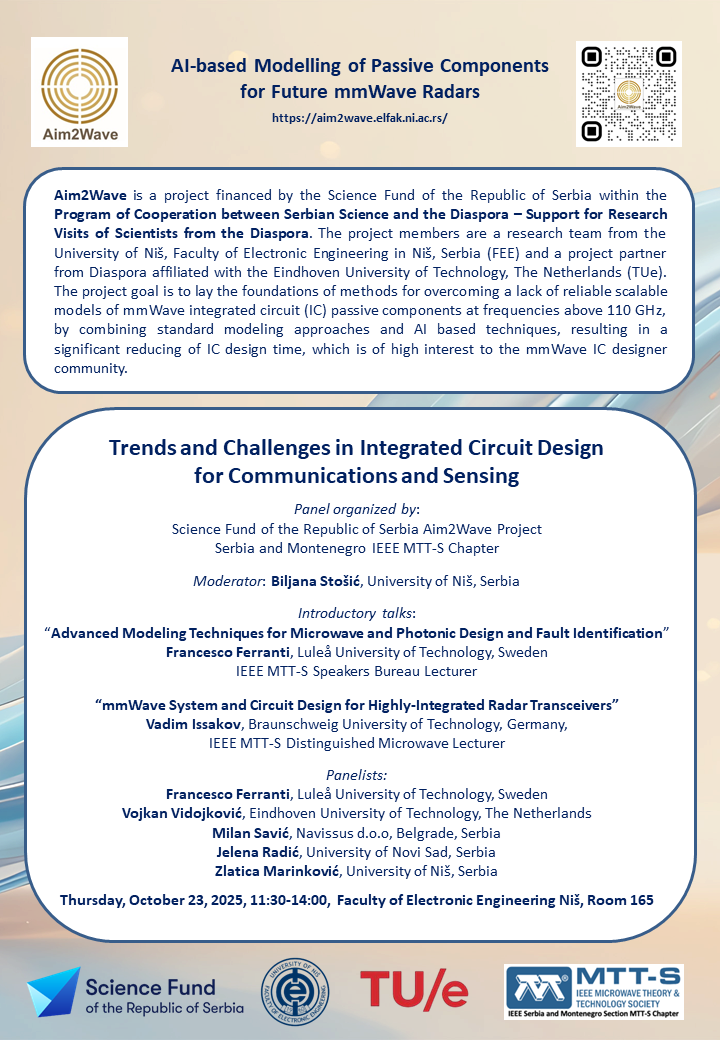
Aim2Wave is a project financed by the Science Fund of the Republic of Serbia within the Program of Cooperation between Serbian Science and the Diaspora – Support for Research Visits of Scientists from the Diaspora. The project members are a research team from the University of Niš, Faculty of Electronic Engineering in Niš, Serbia (FEE) and a project partner from Diaspora affiliated with the Eindhoven University of Technology, The Netherlands (TUe). The project goal is to lay the foundations of methods for overcoming a lack of reliable scalable models of mmWave integrated circuit (IC) passive components at frequencies above 110 GHz, by combining standard modeling approaches and AI based techniques, resulting in a significant reducing of IC design time, which is of high interest to the mmWave IC designer community. The diaspora partner will enhance the Serbian team competences by bringing a reach expertize in mmWave IC design.
The project duration: 01/08/2025-31/07/2026.
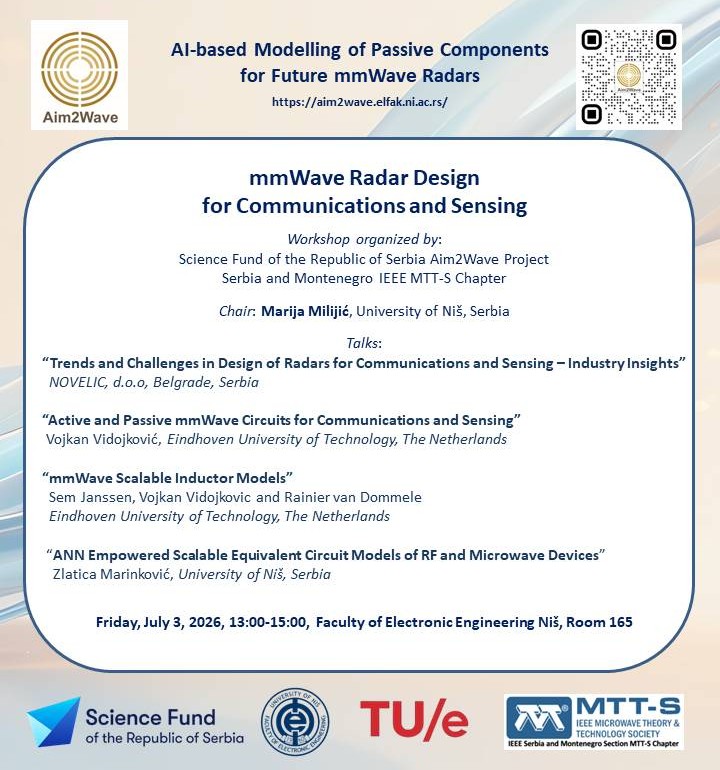
Friday, July 3, 2026, 13:00-15:00, Room 165
Workshop: mmWave Radar Design for Communications and Sensing
Organized by:
Science Fund of the Republic of Serbia
Aim2Wave Project
Serbia and Montenegro IEEE MTT-S Chapter
Chair: Marija Milijić, University of Niš, Serbia
“Trends and Challenges in Design of Radars for Communications and Sensing – Industry Insights”
NOVELIC, d.o.o, Belgrade, Serbia
“Active and Passive mmWave Circuits for Communications and Sensing”
Vojkan Vidojković
Eindhoven University of Technology, The Netherlands
“mmWave Scalable Inductor Models”
Sem Janssen, Vojkan Vidojkovic and Rainier van Dommele
Eindhoven University of Technology, The Netherlands
“ANN Empowered Scalable Equivalent Circuit Models of RF and Microwave Devices”
Zlatica Marinković
University of Niš, Serbia
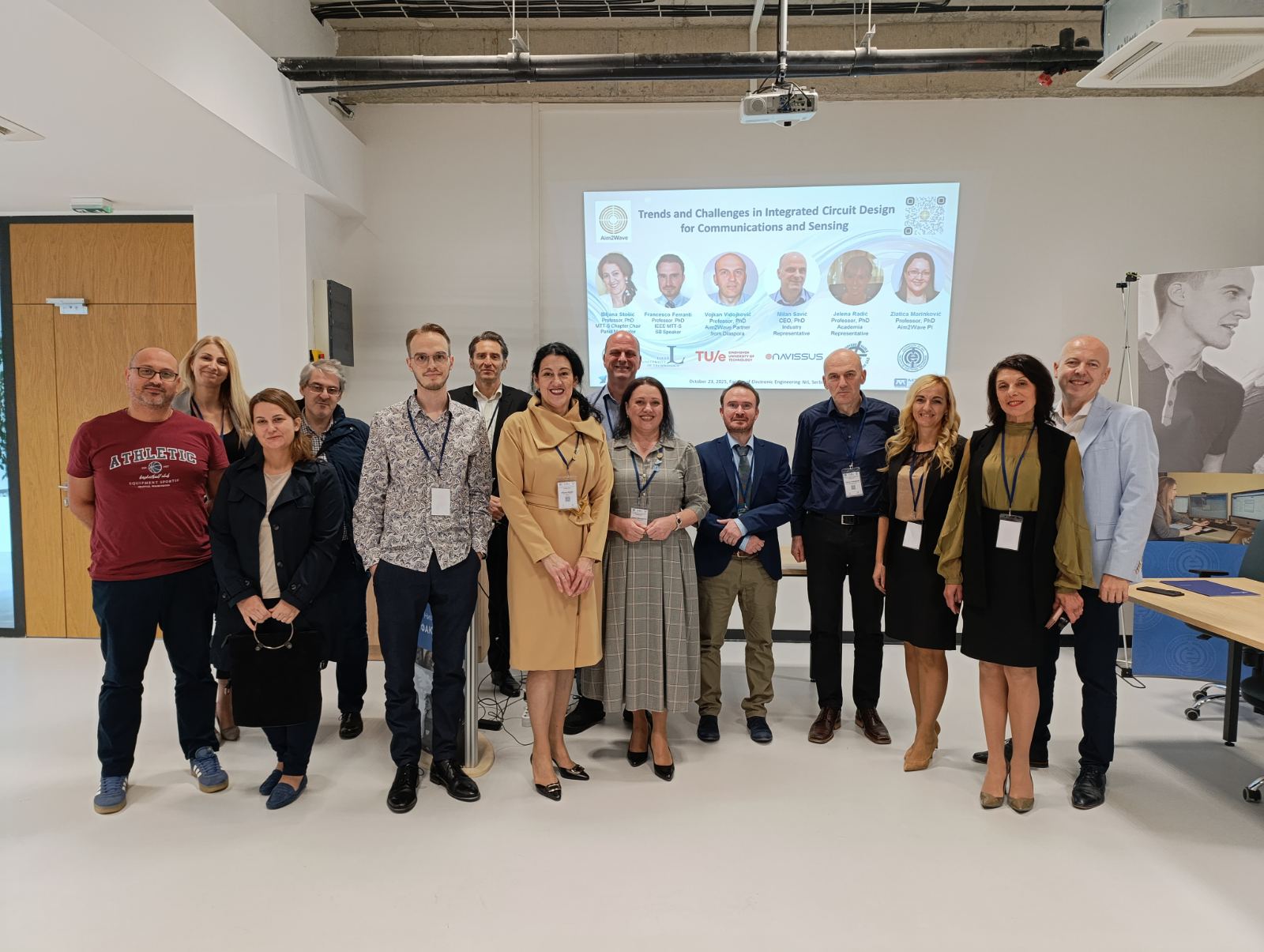
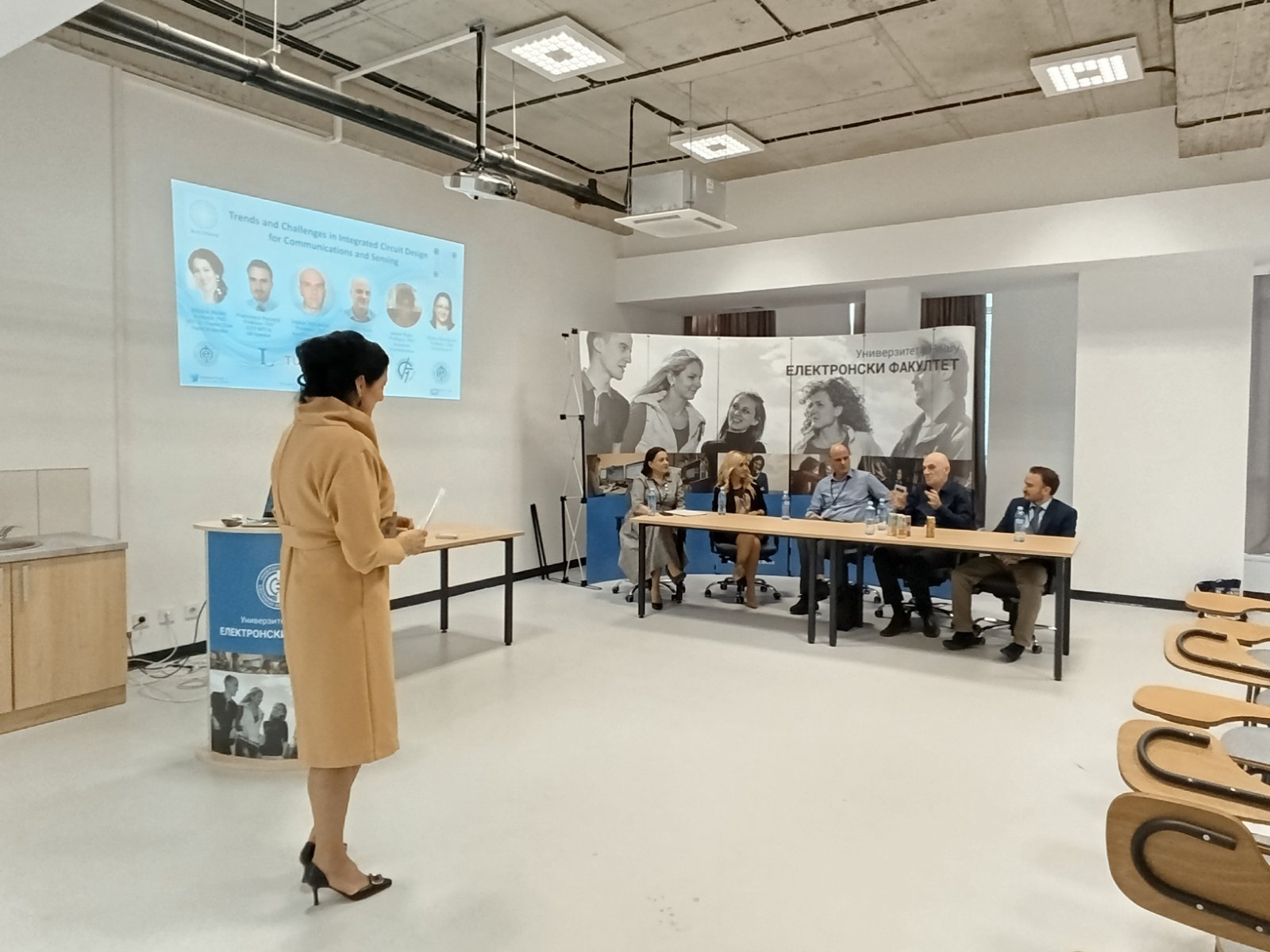
Panel: Trends and Challenges in Integrated Circuit Design for Communications and Sensing
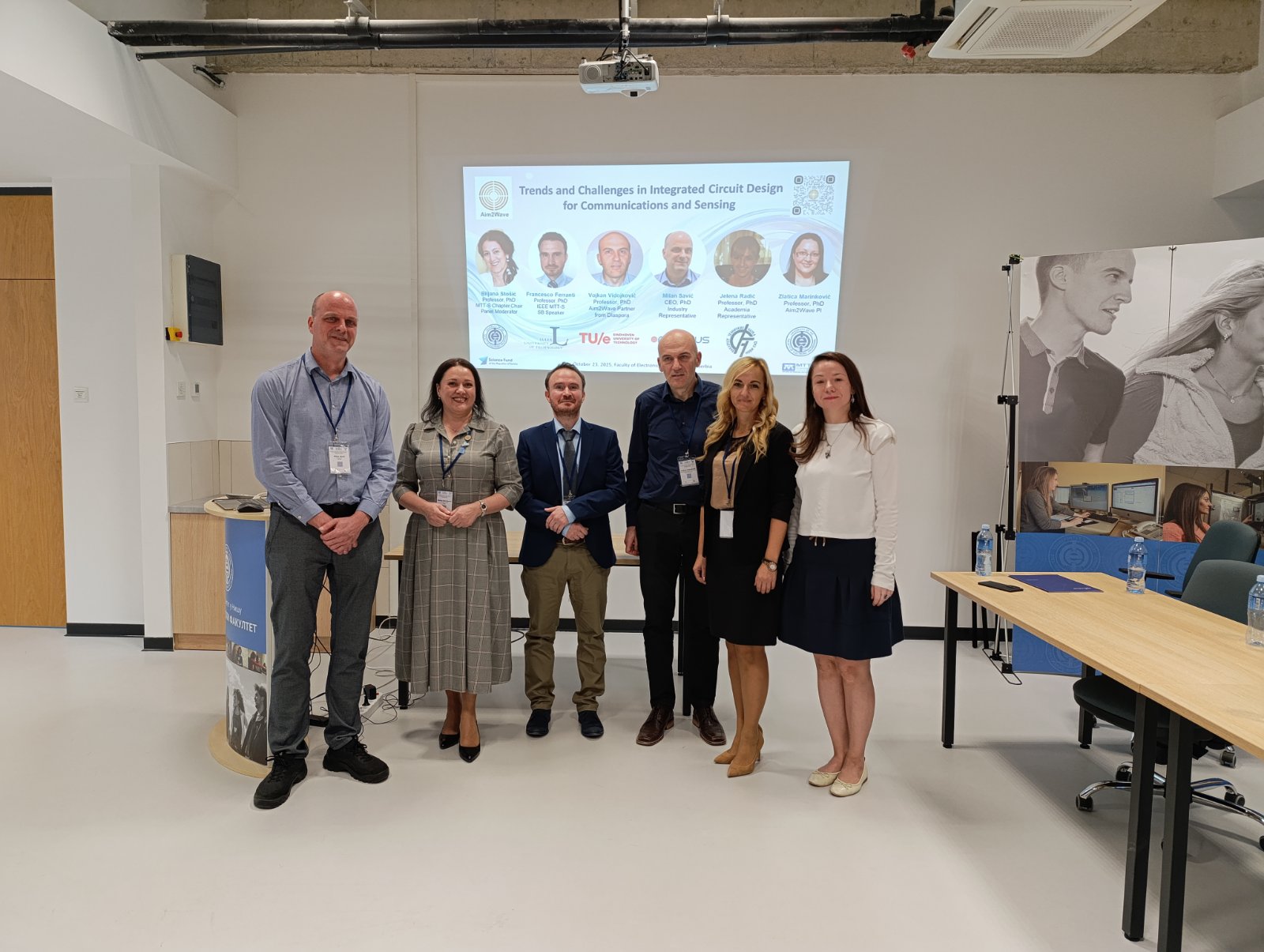
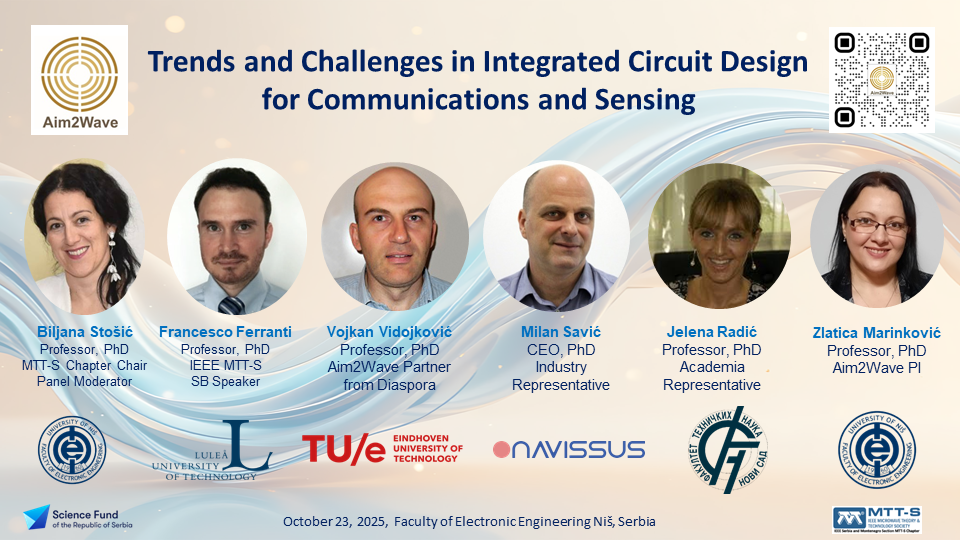
Panel Trends and Challenges in Integrated Circuit Design for Communications and Sensing was organized by Science Fund of the Republic of Serbia - Aim2Wave Project and S&M IEEE MTT-S Chapter. The panel took place on Thursday, October 23, 2025.
The IEEE MTT-S each year carefully selects a group of Distinguished Microwave Lecturers (DMLs). Therefore, DML program offers a list of speakers who are internationally recognized experts and technical leaders in their fields within the Society. The DMLs are available to present talks to local chapters world-wide and serve as ambassadors for the Society. In addition to DML program, MTT-S offers the Speakers Bureau (SB) program as another technical service to its members.
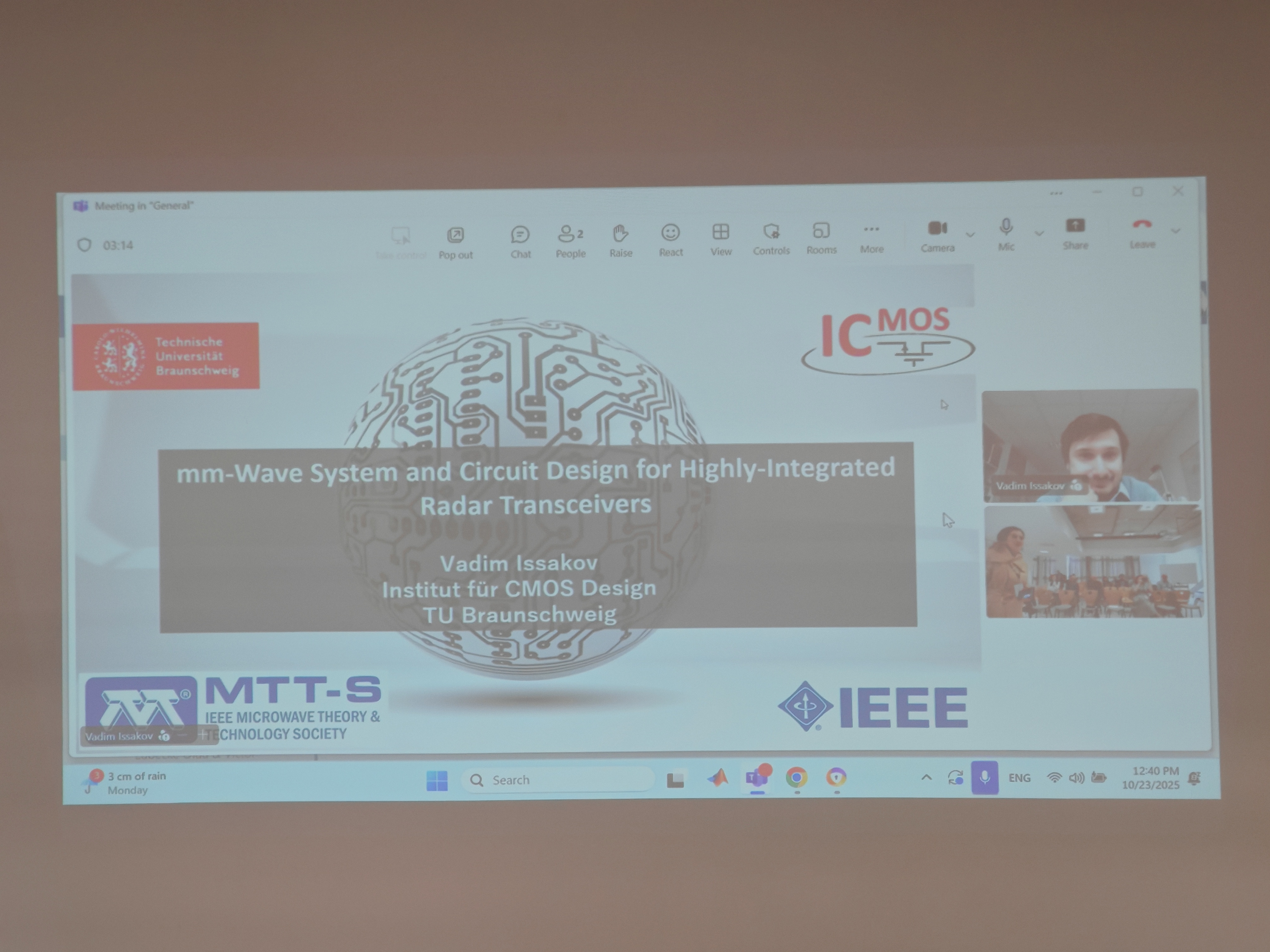
For this occasion, S&M IEEE MTT-S Chapter supported the panel by inviting two MTT-S speakers to give the introductory lectures: Prof. Vadim Issakov from Braunschweig University of Technology, Germany , as a DML speaker to deliver an on-line lecture on “mmWave System and Circuit Design for Highly-Integrated Radar Transceivers”, and as a SB speaker Prof. Francesco Ferranti from Luleå University of Technology, Sweden to deliver an in-person lecture titled “Advanced Modeling Techniques for Microwave and Photonic Design and Fault Identification”. The introductory lectures made a perfect basis for the discussion moderated by Prof. Biljana Stošić, S&M IEEE MTT-S Chapter Chair and Aim2Wave team member. With combined strong industry and university experience, Prof. Vojkan Vidojković, Eindhoven University of Technology, the Aim2Wave Project Partner from Diaspora, highlighted general trends and challenging in IC design. Dr. Milan Savić, Navissus CEO, and Prof. Jelena Radić, University of Novi Sad discussed the IC design challenging in Serbian IC industry and academia. Prof. Ferranti spoke about the application of the innovative techniques in IC design, while Prof. Zlatica Marinković, the Aim2Wave project principal investigator presented the planned activities of the project. Discussion was engaging and opened many new questions to be discussed further and gained a lot of attention of the audience.
The content of this website is the sole responsibility of the authors and does not necessarily reflect the opinion of the Science Fund of the Republic of Serbia.